Count Every Throw: What the Scoreboard Misses Every Week
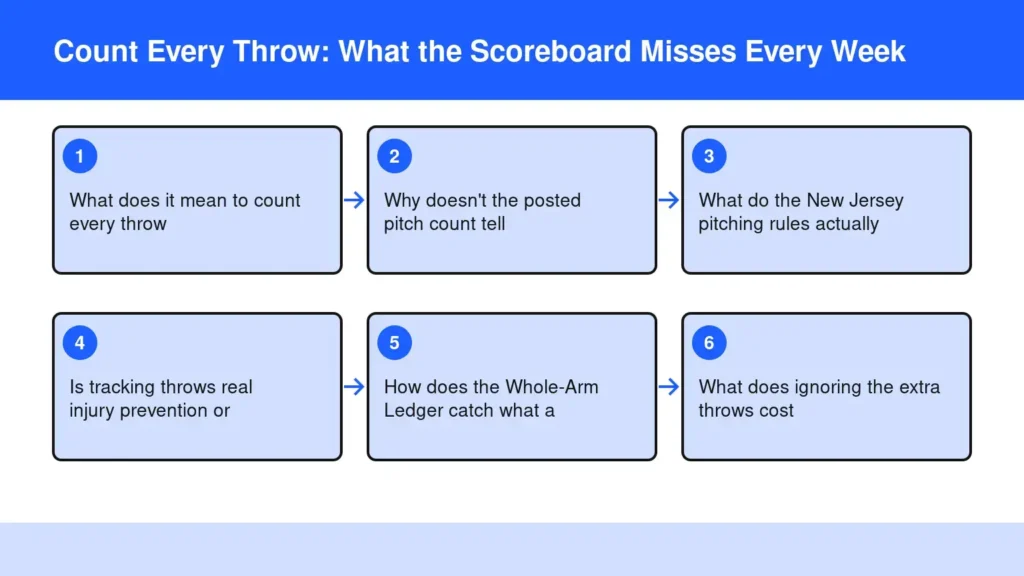
Key takeaways
- Your pitcher almost certainly threw more last week than any official pitch count shows, because bullpens, long toss, warm-ups, catch play and a second team's tournament never reach the scoreboard.
- To count every throw means logging all of it in one place, so you and the coaches decide rest from the full picture instead of a partial one.
Your pitcher almost certainly threw more last week than any official pitch count shows, because bullpens, long toss, warm-ups, catch play and a second team's tournament never reach the scoreboard. To count every throw means logging all of it in one place, so you and the coaches decide rest from the full picture instead of a partial one.
What does it mean to count every throw?
To count every throw means writing down every hard rep your player’s arm makes, on every team, not just the pitches an official counter records. Bullpens. Long toss. Pregame warm-ups. Catch play at practice. The second team’s Saturday tournament.
This is not my invention. In its return-to-play guidance, MLB and USA Baseball’s Pitch Smart tells pitchers to account for long toss, flat-ground work, weighted balls and bullpens, not only game pitches. The arm does not know which ones were official. It only knows the load.
I have worked in strength and conditioning with the Toronto Blue Jays, the Tampa Bay Buccaneers and the University of South Florida, and I hold the CSCS credential from the NSCA. At every level, the lesson is the same. If you aren’t testing, you’re guessing.
Why doesn't the posted pitch count tell the whole story?
A posted pitch count only covers one outing on one team. It cannot see Tuesday’s bullpen, Wednesday’s long toss or what the travel coach asked for on Sunday.
Here is the real problem. Each coach counts honestly, and each coach sees only his own piece. The school coach does not run the travel roster. The travel coach does not attend the school practice. Nobody holds the whole week except you.
Sit with that for a moment. Two adults can each follow the rules perfectly while your kid’s arm carries both loads at once. Pitch Smart compliance research counts avoiding play for multiple teams as part of following the guidelines, and that is the point.
What do the New Jersey pitching rules actually cover?
The New Jersey high school rule covers official school games only. The NJSIAA baseball pitch count rule sets a maximum of 110 pitches per game and names an official pitch counter for both schools.
That rule stops at the school fence. It says nothing about the travel team, the showcase or the backyard. For players outside the school calendar, Pitch Smart lists a daily max of 95 pitches for ages 13 to 14, with required rest days that rise with the count.
Both are real limits from governing bodies. Neither one adds up a week across two teams. That is your job as the parent.
Is tracking throws real injury prevention or just paranoia?
It is real prevention, and the research backs it. In a study of adolescent pitchers in the American Journal of Sports Medicine, overuse and fatigue showed the strongest links to shoulder and elbow injury, and showcase pitching also raised risk.
Tournaments make it worse. A study of youth tournament pitching found noncompliance with Pitch Smart in more than 90% of teams. Many spring weekends put that kind of tournament right on top of a school week.
Counting cannot promise a healthy season. Nothing can. What it may help do is catch a heavy week before the next one piles on top.
How does the Whole-Arm Ledger catch what a scoreboard can't?
The Whole-Arm Ledger is built on one idea: the arm is one vehicle, no matter how many uniforms it wears. It is one of four tools in my free Winning Way starter kit, next to the Player Ledger, the Joy Score and at-bat grades.
A scoreboard records one outing. A ledger works like a bank statement, which lists every purchase and not just the big ones. My advice for any log you keep: note the day, the team, the kind of throwing, and how the arm felt afterward.
Boring is good. A few lines a day compounds into a picture no coach has. When the school coach asks if your pitcher can go Thursday, you answer with a record instead of a hunch.
What does ignoring the extra throws cost?
The honest answer is a shut-down arm in June, right when the season should be at its best. Untracked throws pile up quietly through spring, and the bill arrives late.
A kid who sits out summer loses more than innings. He loses reps, confidence and some of his love for the game. That is the entire stakes.
One rule never bends. If your player feels shoulder or elbow pain, he stops throwing and sees a doctor. Pain is not something to count through.
Frequently asked questions
Should catch play count toward a youth pitcher's weekly workload?
Yes, write it down, even if it feels minor. Easy catch and hard throwing are different loads, so note which kind it was. A written record lets you and the coaches see the pattern across a full week instead of judging each day alone, and it shows when a so-called light day was not light at all.
Yes, write it down, even if it feels minor. Easy catch and hard throwing are different loads, so note which kind it was. A written record lets you and the coaches see the pattern across a full week instead of judging each day alone, and it shows when a so-called light day was not light at all.
Who should keep the arm log, the parent or the player?
The player should own it, with a parent checking in. The career belongs to the player, and logging his own work teaches him to listen to his arm. Your role is to make sure the log exists, that both coaches see it, and that pain always means stopping and seeing a doctor.
The player should own it, with a parent checking in. The career belongs to the player, and logging his own work teaches him to listen to his arm. Your role is to make sure the log exists, that both coaches see it, and that pain always means stopping and seeing a doctor.
Do position players need to track their arm work too?
Yes, especially catchers who also pitch. A catcher who pitches on the weekend has already carried a heavy load behind the plate, and none of that work ever reaches an official pitch count. Treat both roles as one arm, on one page, and make sure both coaches know when the same kid is doing both jobs in the same week.
Yes, especially catchers who also pitch. A catcher who pitches on the weekend has already carried a heavy load behind the plate, and none of that work ever reaches an official pitch count. Treat both roles as one arm, on one page, and make sure both coaches know when the same kid is doing both jobs in the same week.
How do I talk to two coaches about my kid's throwing?
Share the same written record with both of them, early in the spring. Keep it factual: dates, teams and type of throwing. A good coach will welcome it, because neither one can see the other team’s week. Ask them to agree on which days are true rest, then let the log hold everyone to it.
Share the same written record with both of them, early in the spring. Keep it factual: dates, teams and type of throwing. A good coach will welcome it, because neither one can see the other team’s week. Ask them to agree on which days are true rest, then let the log hold everyone to it.
Where can New Jersey coaches learn more about arm care for their teams?
Jim Goetz offers free clinics, coaches’ nights and parent nights for New Jersey programs, listed on the clinics page at jimgoetzbaseball.com. He has coached players from tee-ball to the pros for more than twenty-five years. A coach who brings the whole program in can get parents, players and staff speaking the same language about workload.
Jim Goetz offers free clinics, coaches’ nights and parent nights for New Jersey programs, listed on the clinics page at jimgoetzbaseball.com. He has coached players from tee-ball to the pros for more than twenty-five years. A coach who brings the whole program in can get parents, players and staff speaking the same language about workload.
The Bottom Line
The spring schedule is already on your refrigerator. Before the first doubleheader, start one written record of the arm’s work across every team, and share it with both coaches. The free starter kit holds the Whole-Arm Ledger. You can read more about my background, or bring a parent night or coaches’ night to your program. My forthcoming book goes deeper on all of it.
The scoreboard will keep its count. The only question is whether anyone keeps the real one. Will it be you?
Sources
- MLB Pitch Smart: 2021 Pitching Guidelines
- NJSIAA Baseball Pitch Count Rule 2025-26
- Olsen et al., Risk factors for shoulder and elbow injuries in adolescent baseball pitchers (PubMed)
- Erickson et al., Characteristics Associated With Noncompliance of Current Pitch Smart Guidelines in High School Baseball Pitchers
- Pitching Behaviors in Youth Baseball: Comparison With the Pitch Smart Guidelines
This article is for education only and is not medical advice. If a player has pain, especially arm pain, stop and see a doctor.